Creighton prof wins NIH grant to study teen hearing loss, listening effort
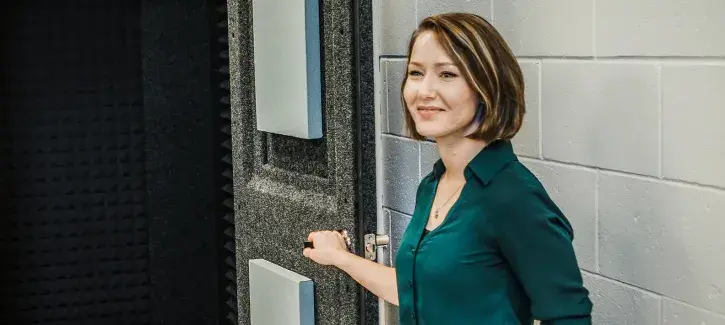
Kelsey Anbuhl, PhD, assistant professor of biomedical sciences at Creighton University, has been awarded a prestigious R00 grant from the National Institutes of Health (NIH) totaling $726,177 to advance her groundbreaking research into hearing loss among adolescents—a population often overlooked in auditory health studies.
The NIH R00 grant, one of the most competitive and sought-after funding mechanisms in the biomedical sciences, will support the next phase of Anbuhl’s research into the brain mechanisms that underlie “listening effort”—the cognitive and neural exertion required to understand speech and sound, particularly in individuals with hearing loss.
“People with hearing loss exert additional mental effort to understand speech, and the resulting cognitive fatigue can have long-term negative consequences for quality of life,” says Anbuhl, whose personal experience with hearing loss has fueled her scientific inquiry.
A New Neural Circuit for Listening Effort

In the first phase of her research—now completed—Anbuhl made a striking discovery: a previously unidentified neural pathway in the brain that appears to be associated with listening effort. This circuit was identified using a preclinical animal model, Mongolian gerbils, a well-established model organism in auditory neuroscience due to their hearing range, which closely mirrors that of humans.
This newly discovered pathway may play a crucial role in how the brain allocates resources to process sound when hearing is impaired. Anbuhl’s findings have provided a biological framework for understanding the everyday experiences of people with hearing loss—how much harder the brain must work to make sense of sound, understand speech and navigate the world, says Anbuhl.
Adolescents and the Hidden Toll of Hearing Loss
While much research on hearing loss has focused on infants and older adults, adolescents have received comparatively little attention despite evidence that they, too, face unique challenges.
Adolescents are at a critical stage of development when they form social identities, establish academic habits and hone communication skills. The additional cognitive fatigue hearing loss induces can have ripple effects on mental health, peer relationships, school performance and later success in the workplace.
The second phase of Anbuhl’s research, funded by the new NIH grant, will explore these implications more deeply. The goal is to bridge the gap between biological mechanisms and lived experiences to inform better interventions, technologies and support systems for young people navigating the world with hearing deficits.
Advancing Inclusive Auditory Health at Creighton
Anbuhl joined Creighton’s faculty in 2024, drawn to the University by the opportunity to work with Peter Steyger, PhD, professor of biomedical science, at the Dr. Richard J. Bellucci Translational Hearing Center.
“I really wanted to be in a place where I could be around other scientists who care about hearing loss,” Anbuhl says. “And there really aren’t that many places like Creighton in the U.S.”
“The Center for Translational Hearing was a huge appeal for me because it has so many researchers who are studying hearing and hearing loss, from molecular mechanisms to kids with cochlear implants at Boys Town,” she continues.
Creighton faculty within the Center have received numerous grants in the past year to advance understanding of hearing loss. This most recent NIH grant is another milestone in the University’s growing reputation as a center for innovative neuroscience in the field of hearing and hearing loss.