Creighton professor wins $500K NSF grant to study invasive species in Loess Hills
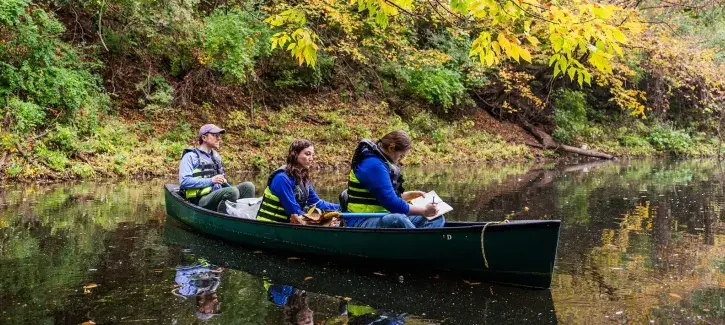
Creighton University biologist Joseph Phillips, PhD, assistant professor of biology, has received a three-year $500,448 grant from the National Science Foundation (NSF) to investigate how invasive plants are reshaping aquatic ecosystems in Iowa’s Loess Hills.
The award, part of NSF’s Building Research Capacity in Biology program, supports pre-tenure faculty at universities that emphasize undergraduate education. For Creighton, which has a strong teaching focus and growing research profile, the grant strengthens faculty scholarship and expands undergraduate research opportunities.
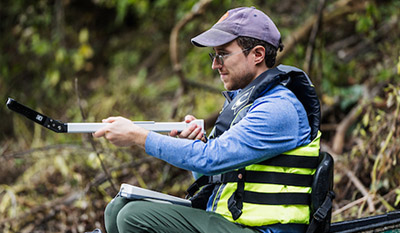
“This grant will support the purchase of approximately $50,000 worth of specialized equipment that our department would not otherwise be able to afford,” says Phillips, the project’s principal investigator. “Chief among these is a leaf canopy analyzer, which will allow us to measure the total leaf area overhanging our study pond from different tree species, a fairly unique feature of our project.”
Additionally, funds will support “highly targeted analyses of stable isotope composition of tree leaves and aquatic insects,” continues Phillips, “that will hopefully enable us to differentiate contributions of various tree species to the pond food web.”
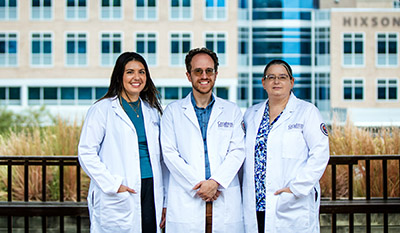
Phillips is joined by co-investigators Mackenzie Taylor, PhD, associate professor of biology, and Marie Adomako, PhD, assistant professor of biology. Together, the team brings expertise in ecology, botany and microbiology to explore how leaf litter from both native and invasive trees affects aquatic life.
The Loess Hills: A living laboratory for Creighton research
Stretching across western Iowa, the Loess Hills are among the world’s deepest silt deposits—an ecologically unique region of bluffs, prairies and streams. “This topographic complexity promotes a diversity of habitats in close proximity,” says Phillips, making the region a “hotspot of biodiversity.”
Phillips grew up exploring the hills and collaborates with The Naturalist School, an Iowa-based nonprofit based in Waubonsie State Park, to engage local communities in Creighton’s research and conservation work.
Understanding impact of invasive species
The project focuses on two non-native woody plants: Amur honeysuckle and autumn olive. Both were introduced decades ago as part of conservation plantings but have since spread aggressively. Their encroachment threatens native shrubs and trees, with ripple effects for the streams and ponds below.
Tree leaves are critical to many aquatic systems. When they fall, they provide organic matter for insects and microbes that form the base of the food web. The question, Phillips explains, is whether invasive species provide the same ecological benefits as native trees such as oaks and elms.
“Our research fits within a broader trait-based approach to community ecology,” he says. The team is looking at how differences in leaf toughness, chemistry and decomposition rates influence aquatic communities. Early findings suggest that the invasive species decompose more rapidly, supporting fewer invertebrates.
Collaboration across science disciplines
Each faculty member brings a distinct lens to the project. Taylor, a botanist, characterizes the anatomy and chemistry of leaves. Adomako, a microbiologist, studies the fungi and bacteria involved in decomposition. Phillips, an ecologist, focuses on aquatic insects and invertebrates.
“A sense of community is so important in science, and it is a privilege to work with such a dynamic team,” Phillips says.
Creighton student researchers in the field and lab
The collaboration also extends to students. The grant funds three undergraduates each summer, giving them hands-on training in both field and lab settings.
Senior biology major Tyler Rossmanith says the project has strengthened his skills in data collection and analysis while shaping his career path. The Fort Dodge, Iowa, native says he’s developed such key research skills as designing experiments, collecting and analyzing data and translating those findings into scientific literature—all skills he believes will help prepare him for medical school.
“I think it is important for undergraduates to access research opportunities because it helps develop skills outside the classroom relevant to their career path,” he says.
Working under Taylor and with the rest of the team has “exposed me to the importance of environmental science as it relates to preservation of environments and their impact on human life,” Rossmanith says. Of particular interest is the sheer volume of factors that influence the homeostasis of an ecosystem: “One small change in one factor can completely disrupt the ecosystem.”
Darija Trumbo, a junior from Kula, Hawai’i, was interested in pursuing research through the CURAS Summer of Undergraduate Research Fellowship (SURF) when Adomako suggested she join the NSF project. The biology major and Spanish and Hispanic studies minor has been an enthusiastic team member ever since and echoes the importance of hands-on experience.
Balancing work in Waubonsie’s streams with microbiology lab analysis has been especially rewarding because it provides a complete lens to witness firsthand the intricate workings of an ecosystem in the field and then develop its microbial profile in the lab. This research experience “has influenced my consideration of jumping into a professional research field through the possibility of an MD-PhD track” in the future, Trumbo says.
For junior biology major and philosophy minor Joe Geiser, a family trip to Alaksa initially spurred an interest in aquatic ecosystems. Geiser, who is from San Diego, plans to pursue a career in marine biology and calls his NSF-funded research “an amazing opportunity.”
“It has shown me the sort of field knowledge I require to work in the biological sciences,” he says.
Geiser has been studying how aquatic invertebrates respond to different kinds of leaf litter. During his time at the test sites, taking values such as temperature, pH and chlorophyll levels, he has discovered a love of field work. While he enjoys his time in the lab, “being hands-on with the ecosystem that I am studying is much more fulfilling to me than working at a desk,” he says.
From the Loess Hills to the larger world
Invasive honeysuckle and autumn olive are spreading across eastern North America, making research vital for future conservation strategies.
“It’s easy to say that invasive plants should simply be removed, but the wisdom of doing so needs to account for the void left by removing those plants,” Phillips says. “Ecology is rarely black and white,” he adds.
As Phillips sees it, the blend of rigorous science, student engagement and public collaboration embodies Creighton’s mission. “Creighton offers so many undergraduate research opportunities,” he says. “Externally funded projects like ours are valuable for their scope and visibility, but the best way for students to learn the scientific process is to get involved early.”
If you are interested in studying biology and gaining research experience as an undergraduate, explore Creighton’s undergraduate research opportunities.