Making inroads in Africa
Cut jaggedly by seasonal rains and hard fired in the oppressive African heat, the minefield of deep ruts and stiff bumps along the dirt road leading into the Kakuma Refugee Camp in northwest Kenya tells a story of difficult journeys. There are no street signs. You are here and nowhere.
The 300,000 refugees — chased by the demons of war, famine and injustice — are unmoored from any traditional country boundaries but are trapped, largely, within the confines of the camp’s 250,000 rugged, arid acres.
Some of the refugees were born here; others have been here for years. They have navigated painful paths — leaving families, escaping war-decimated homes and villages; traveling for miles and days on foot, or perilously crossing borders. In the camp, they live day to day — waiting in line for food and water rations, abiding by nightly curfews and facing the vagaries of police patrols.
Opened in 1992 to serve as a refuge for the “Lost Boys” of Sudan, the camp’s population has continued to swell, with new arrivals coming from South Sudan, Somalia, Ethiopia, the Democratic Republic of the Congo and elsewhere in the region.
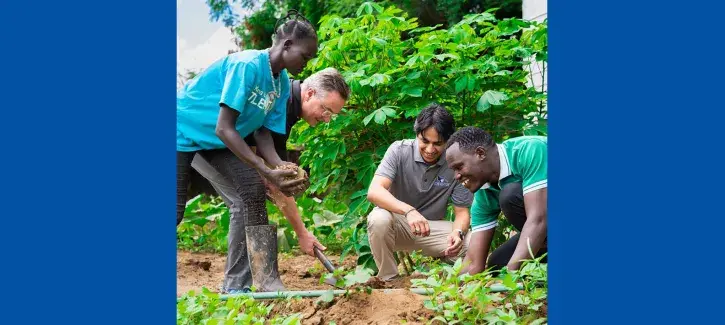
They are individuals and families without a permanent home. But they are not alone. The Jesuits and Creighton University are walking alongside them, providing opportunities for education, skills training and entrepreneurship.
Jesuit and Creighton Partnership Expands Educational Access
Accompaniment begins with building relationships. Jesuit Refugee Services (JRS), founded in 1980 and operating in more than 50 countries, oversees seven secondary schools (benefiting 14,000 learners) and various skill-development and other programs at Kakuma, as well as nine Catholic churches across Kakuma and Kalobeyei (another refugee camp in Kenya). Jesuit Worldwide Learning (JWL), founded in 2010, provides online education for refugees in more than 30 countries, including at Kakuma. JRS and JWL also operate at Dzaleka, a prison turned refugee camp opened in 1994 near Malawi’s capital city of Lilongwe, housing 52,000 refugees.
Creighton President the Rev. Daniel S. Hendrickson, SJ, PhD, who serves on the Global Advisory Board for JWL, has led delegations of Creighton alumni and benefactors to Africa to see this work firsthand, and this past spring guided a delegation of several Creighton students.
“Through our association with our Jesuit partners, we have been fostering these relationships in Africa,” Fr. Hendrickson says. “This year, we took a small group of students to see how we can expand and deepen those connections. Our students and those they met — in the refugee camps, in the Kibera slums, at St. Aloysius Gonzaga Secondary School, co-founded by a Jesuit to educate AIDS orphans, at Jesuit-run Hekima College — shared their personal stories and asked questions. It fostered learning and understanding on many levels. It was so clearly a meaningful experience for all involved, perhaps even life-changing for some.”
“This journey has deeply enriched my Creighton education by showing me the living, breathing embodiment of Jesuit values, being women and men for and with others,” writes Mark Menezes, a junior premed major from Fort Collins, Colorado, in a post-trip reflection. “I saw this in the way the Jesuits live on the margins until the margins no longer exist, and in their belief that faith doesn’t follow achievement, it precedes it.
“I was reminded that learning is not only academic, but experiential and relational. It’s not just about understanding systems of injustice, but about standing alongside those impacted by them and working together for something better.”
Innovation Grants Help Refugees Build Sustainable Futures
Creighton serves as the school of record for JWL’s pre-STEM certificate program, which combines liberal studies courses with an emphasis on math and science and a pathway to complete an online bachelor’s degree in general studies from Saint Louis University, another Jesuit university. Creighton also offers a Global English Language (GEL) Teacher Training Certificate course and manages an Innovation Grants program funded by Creighton donors supporting startup businesses at Kakuma and Dzaleka.
Odi Abraham, a 29-year-old living at Kakuma, who fled Sudan 13 years ago when civil war decimated his village in the Nuba Mountains, is a grant recipient, using the funds to establish a small poultry business that provides eggs and chickens for the community. Fleeing Sudan, he traveled on foot for three days, the whereabouts of his parents and family members unknown. (Recently, he reunited with siblings and cousins at Kakuma.) Subsequent grant installments have allowed him to add an incubator, powered by rooftop solar panels.
“I remember meeting a team from Creighton, as a JWL student, and having the opportunity to present my idea to them,” Abraham says. “I was excited when my idea was accepted by Creighton. I felt it was a blessing to me.
“I am very hopeful, and I’m pretty sure I will find myself back in Sudan one day. I would like to be the change that I would always like to see.”