Poetry finds a home in Creighton’s School of Medicine
In a field often defined by science and precision, Creighton University’s School of Medicine is inviting something new into the conversation: poetry.
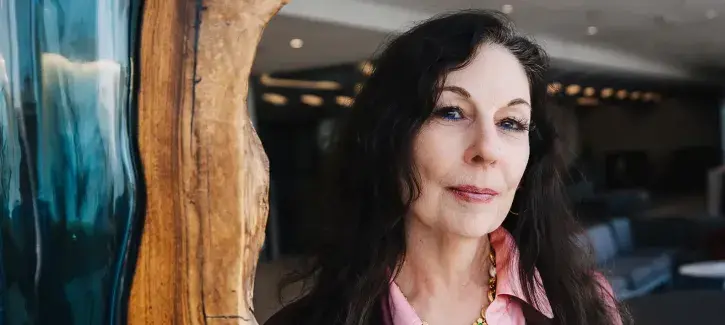
Last spring, Janna Lopez, MFA, joined the School of Medicine as its inaugural poet-in-residence, a role designed to help future physicians connect the art of reflection with the science of healing
“Medicine and education are at a precipice right now,” Lopez said. “Our attention spans are waning and we have less and less time to connect with ourselves and reflect. The moment is now to emphasize even more the importance of expression and being human. It’s what keeps us connected.”
Rooted in Ignatian reflection
At Creighton, that practice of thoughtful self-examination is rooted in the Ignatian value of reflection, a hallmark of Jesuit education that invites students to pause, discern and act with greater purpose.
As poet-in-residence, Lopez works with faculty and students through Creighton’s Department of Medical Humanities to help them explore the human side of medicine. Her position is one of only a few in the nation and reflects Creighton’s commitment to forming physicians who are not only skilled clinicians but compassionate listeners and reflective thinkers.
Her work builds on the foundation of Creighton’s medical humanities program, which integrates disciplines such as literature, theology, philosophy and art into medical education.
“Engaging with the humanities cultivates deeper insight into the lived experience of health, illness and care,” said Nicole Piemonte, PhD, associate dean for faculty leadership and clinical associate professor of medical humanities. “Medicine involves attending to the human being as much as to the human body. What we’re developing in the medical humanities is a richer way of seeing and knowing patients, ourselves and the world around us.”
Exploring the human side of medicine
Through her workshops, Lopez introduces students and faculty to her method of Poetic Intelligence, a practice built on curiosity, observation and invitation.
“Most people are intimidated by poetry because they don’t know how to access it,” she said. “But once they do, it disarms and challenges them to think in new ways. Helping medical students balance their research-driven minds with creativity gives their brains a chance to breathe. It also gives them a lifelong process to internalize and express the complex emotions they’ll face in medicine.”
For Lopez, poetry is a powerful tool for formation. She believes it gives students a framework for empathy, self-awareness and reflection—qualities essential to compassionate care.
“These are young people who will experience life and death, mistakes, diagnoses and immense pressure,” she said. “Having a creative outlet helps them process all that. It keeps them human.”
Lopez said some of the most meaningful outcomes so far have come from faculty members who have rediscovered their own creative voices through her sessions.
“Seeing a 35-year academic veteran light up after writing a poem he’s proud of—there’s no feeling like it,” she said. “It’s incredible.”
A foundation for compassionate care
Her approach, and the School of Medicine’s investment in the humanities, highlight a shared belief that reflection and empathy are as vital to medical practice as scientific expertise.
“Because our medical school is focused on character formation, we have a strong emphasis on the humanities,” said Robert Dunlay, MD, dean of the School of Medicine. “We know that narrative imagination—the ability to look at a situation from the perspective of patients, families and coworkers—is critical to being a great physician.”
Lopez agrees that poetry can nurture that imagination and compassion, reminding students why they chose this vocation in the first place.
“The practice of medicine, at its core, is about human connection,” she said. “Although medicine is rooted in science, it’s really more of an art because every person is unique. Both medicine and poetry draw on stories and wisdom that come together in a single moment of expression.”
Lopez sees her work as part of Creighton’s larger mission to prepare physicians who treat the whole person.
“The leadership at Creighton and within the School of Medicine is deeply committed to finding innovation and meaning in medicine,” she said. “That’s rare, and I’m so grateful to be part of it.”