The School of Medicine welcomes diverse, inspiring students
It's never too late to find your true calling.
After nearly ten years working in politics and corporate America, incoming medical student Joel Dumonsau decided it was time to pursue the intangible pull he always felt toward medicine.
The COVID-19 pandemic was his turning point – a chance to re-spark his passion for healthcare. He says, “For me, it was an opportunity to put a lot of the things that I had been doing in my life on pause and transition to a career in medicine.”
That was it; it was decided. Dumonsau was going to apply for medical school.
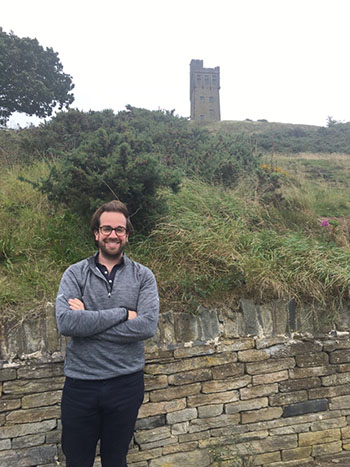
To prepare for the application process for medical school, he took classes and worked in a hospital setting as a research assistant, observing procedures and talking with patients about their experiences as part of his studies. “I got a lot of exposure to people really going through acute crises in their lives,” Dumonsau says.
Exploring the human aspects – the art – of medicine contributed to his formation. “I’m interested in opportunities to engage with others, to care about different people's life perspectives and to, frankly, be a little bit uncomfortable because that's where growth happens,” he adds.
That’s when he set his sights on Creighton. “The ultimate objective is to become a doctor, but I want to do it in a way that’s authentic to me,” Dumonsau says.
As a service-minded individual, he knew he wanted to use his education to serve those in tough situations, aligning with Creighton’s ethical and humanistic approach to medicine.
Though he knew it would be a hard path, medical school was what Dumonsau knew would make him feel fulfilled. “When I was accepted to Creighton, it was a really exciting feeling,” he recalls. “I told the admissions team they kind of just made my whole life.”
To Dumonsau, his journey to medical school was worth the wait. “As someone who’s 34 and married and has gone through a multitude of life experiences,” he says, “I feel I'm in a position where I can really relate to people and my patients.”
This incredible – and non-traditional – path is one of 250 unique stories that make up the class of 2028.
Impressive academics are a mark of a Creighton physician, and this class is no exception, with a mean MCAT score of 513 and a mean GPA of 3.82. The national average MCAT score is under 502.
In addition, 34 states are represented, with California (65), Arizona (27) and Minnesota (21) taking the lead.
In 2023, the medical school in Phoenix expanded its capacity from 100 spots to 120, making the academic year 2025-2026 another record-breaking year for the number of medical students on the campus. Arizona’s second-place ranking for the home state of incoming students further reflects the School of Medicine’s promise to address the healthcare workforce shortage in the southwest – attracting local students who may stay in the state upon graduation.
In addition to academic excellence, a deep commitment to service and justice is a mark of a Creighton physician, making Dumonsau and the other 249 incoming medical students a perfect fit, especially as 100% of Creighton medical students volunteer in clinics, their communities and globally.
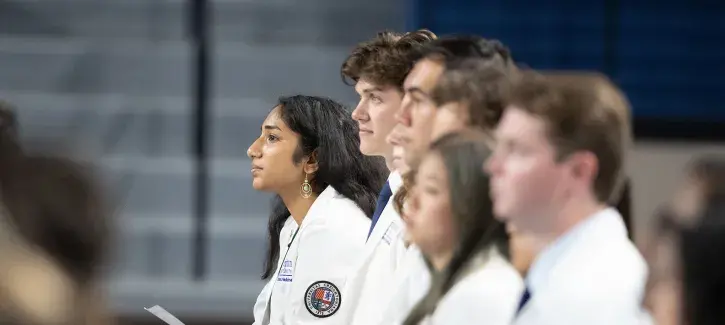
These diverse, academically gifted medical students will soon find a home at Creighton University after the upcoming White Coat Ceremonies when the School of Medicine will welcome the Class of 2028.