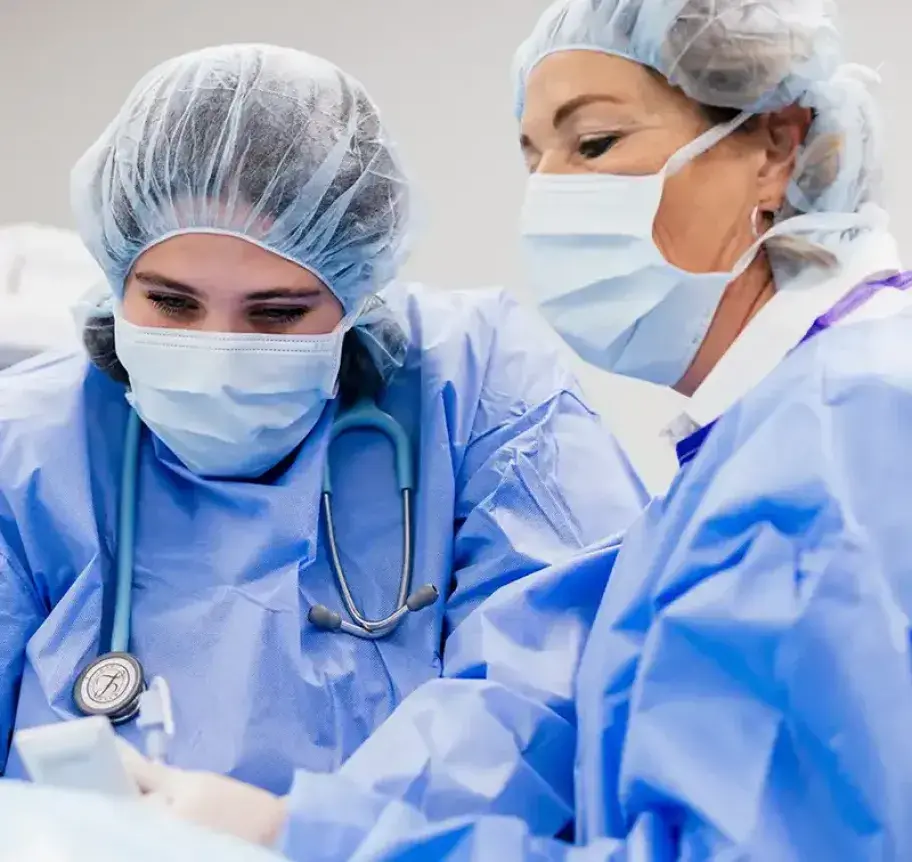
Nurses applying anesthesia to patient
On Campus

Nurse Anesthesia (DNP-NA)

Step into one of the fastest growing and most rewarding careers in healthcare. As a Certified Registered Nurse Anesthetist (CRNA), you will play a vital role in patient care, providing expertise, leadership and innovation in a field where demand is rapidly rising due to expanding healthcare needs and an aging population.

At Creighton University’s College of Nursing, our Nurse Anesthesia program prepares you with:

  • Comprehensive training in advanced anesthesia practices
  • Hands-on clinical experience in both urban and rural healthcare settings — from hospitals and surgical centers to outpatient clinics
  • Leadership development grounded in ethical decision-making and compassionate care

At Creighton, you’ll graduate ready to make an impact — in practice, in leadership and in the future of nurse anesthesia.

Overview of the Nurse Anesthesia (DNP-NA) Program

Creighton University’s Doctor of Nursing Practice in Nurse Anesthesia (DNP-NA) is a comprehensive, full-time, 36-month doctoral program based on our Omaha campus.  

The curriculum blends in-person and online learning, led by expert CRNA faculty and doctoral-prepared professors specializing in leadership, evidence-based practice, scholarship and policy/advocacy.  

Our faculty are deeply invested in students’ personal and professional success and engage alongside students in meaningful research and scholarship throughout the program.

Grounded in Creighton’s Jesuit value of cura personalis—care for the whole person—the DNP-NA program emphasizes both academic excellence and compassionate service to the communities we serve.  

The DNP-NA program builds on the proud history of transformative nursing education at Creighton—one that spans nearly a century.  

Program highlights include:

  • Extensive Clinical Experience at Rural and Metropolitan Hospitals
    Gain more than 2,500 clinical hours at large metro-area hospitals, rural and specialty hospitals and community clinics to prepare as a confident, practice-ready nurse anesthetist.  
  • Immersive Simulation Training  
    Complete 300 lab/simulation hours in Creighton’s CL and Rachel Werner Center for Health Sciences Education, featuring state-of-the-art equipment and clinical simulation labs.  
  • Advanced Technology Integration  
    Build expertise in Regional Anesthesia and Point of Care Ultrasound (POCUS) through dedicated lab hours and hands-on training.  
  • Comprehensive Pain Management Education
    Develop knowledge in acute and chronic pain management to address the growing need for skilled pain specialists in healthcare.  
  • Interprofessional and Leadership Development  
    Benefit from specialized coursework in ethics, information technology, quality care, leadership, business and interprofessional collaboration.  

Graduates of Creighton’s DNP-NA program are prepared to sit for the National Board of Certification and Recertification for Nurse Anesthetists (NBCRNA) National Certification Examination (NCE) and to step confidently into the profession as ethical and compassionate clinicians, skilled leaders in healthcare and education, and advocates for patients and the nursing profession.  

Admission Requirements

Application Materials

  • Application
  • Official transcripts from every college/university attended
  • RN or APRN license (see requirements below)
  • Personal statement, answering two questions provided in the application.
  • Resume
  • Three professional letters of recommendation, one from a current direct supervisor
  • Job shadowing form

Selected candidates will be invited to an in-person interview. Interview dates will be published in 2026.

Program Requirements and Prerequisites

  • Minimum cumulative 3.0 GPA on a 4.0 scale
  • 3 Credit Hours of Graduate Statistics (Grade of B or Higher)
  • Undergraduate Physical Assessment Course (Grade of C or Higher)
  • Grade of B or above in each of the following courses
    • Anatomy
    • Physiology
    • Microbiology
    • Biochemistry
    • Pharmacology
  • A bachelor’s degree in nursing (BSN) and/or a master’s degree in nursing from a CCNE ACEN, or NLN-CNEA accredited college or university.
  • An active unencumbered license as a registered nurse (RN) or advanced practice registered nurse(APRN) in the United States.  If admitted, must have eligibility to practice in the state of Nebraska prior to registering for classes.
  • One year of full-time, direct patient care experience in a critical care area by the application deadline (examples include but are not limited to: surgical, cardiothoracic, coronary, medical, pediatric and neonatal intensive care units) within the United States, its territories or a U.S. military hospital outside of the U.S. During this time the applicant must have developed critical decision making and psychomotor skills, competency in patient assessment, and the ability to use and interpret advanced monitoring techniques.
  • Job shadowing of a clinical CRNA required
  • Certifications required
    • Basic Life Support
    • Advanced Cardiovascular Life Support

International Applicants

Due to the specific features and requirements of this program, international students cannot be admitted. Unique situations may be discussed with your admissions advisor.

International Transcripts

Any course work taken at an accredited institution outside of the United States must be evaluated course-by-course by a NACES approved credentialing agency. A list of approved agencies can be found here. Official evaluations must be sent directly from the agency to Creighton University.

English Language Proficiency Requirement

English Language Proficiency is an important part of the application process for those whose first language is not English. The College of Nursing has the discretion to determine individual standards for how this requirement will be met using one or more of the following:

  • English Language exam scores. All applicants who have obtained a degree outside of the United States must present a TOEFL score of at least 100 an IELTS score of at least 7, or a DuoLingo score of at least 120. Scores over 2 years old will not be accepted. Students must ask the testing agency to send original scores to Creighton University (Institutional Code 6121).
  • Completion of an undergraduate degree from one of the following countries: Australia, Canada, Barbados, Bahamas, Bermuda, British Virgin Islands, Cayman Islands, Dominica, Grenada, Guam, Ireland, Jamaica, Marshall Islands, New Zealand, St. Kitts, St. Lucia, Scotland, Singapore, Trinidad and Tobago, United Kingdom, United States, and Virgin Islands.

The College of Nursing reserves the right to require students to re-take the exam. It is also at the discretion of the College of Nursing as to whether an English Language Proficiency exam is required of applicants who have earned a college degree from a university in the United States or another approved country.

Dates and Deadlines

Applications for the August 2027 cohort will open in the summer of 2026 and close in November 2026.

Selected candidates who demonstrate exceptional promise will be invited to interview.

Interviews will be held in person at the Omaha campus in early 2027. Dates will be published in 2026.

In order to be notified when the application opens, please request information using the form.

Stat 214,200
$214,200

annual mean pay U.S. Bureau of Labor Statistics

Stat 12,500
12,500

anesthesia providers needed in the U.S. to meet healthcare demand (by 2033)

Stat 100
100%

anesthesia care at critical access hospitals in rural Nebraska provided by CRNAs

“At Creighton, we are building more than a program – we are shaping a community of nurse anesthetists who will be confident leaders, ethical practitioners and unwavering advocates for their patients and profession.”

Holly Chandler, EdD, CRNA, FAANA

Program Director

Frequently Asked Questions

What is the learning format for the Creighton DNP-NA program?

The program offers a blended learning experience, combining both in-person and online coursework. During the first two semesters, many courses are delivered online. However, some courses require on-campus participation, and students are expected to be physically present for the duration of the three-year program. 

This hybrid model provides flexibility through online learning while maintaining the hands-on, collaborative experiences that define a Creighton education.

What does a Certified Registered Nurse Anesthetist (CRNA) actually do during surgery?

Certified Registered Nurse Anesthetists (CRNAs) are advanced practice nurses who manage every stage of anesthesia care:

  • Prepare patients: Review medical histories, develop anesthesia plans and explain options.
  • Administer and monitor anesthesia: Deliver medications, track vital signs and adjust care in real time to keep patients safe and comfortable.
  • Ensure smooth recovery: Wake patients, manage pain and monitor for complications.

In many hospitals and surgery centers—especially in rural settings—CRNAs serve as the primary anesthesia providers, giving you both independence and leadership opportunities. It’s a critical, hands-on role for nurses ready to advance their skills and make a direct impact on patient outcomes.

What is the demand for anesthesia providers?

The demand for anesthesia providers—especially Certified Registered Nurse Anesthetists (CRNAs)—is growing rapidly across the United States. With an aging population, increased surgical needs and many current providers approaching retirement, national projections point to a significant shortfall.

By 2033, the U.S. could face a shortage of about 12,500 anesthesia providers, and the Health Resources & Services Administration (HRSA) estimates a gap of 8,450 anesthesiologists by 2037. CRNAs are uniquely positioned to fill this need, particularly in rural and underserved communities where they already deliver the vast majority of anesthesia care. For students entering the profession, this translates into strong job security, competitive salaries and a wide variety of practice opportunities across the country.

What kinds of simulation or clinical experiences should I expect during CRNA training?

CRNA training combines high-fidelity simulation and hands-on clinical rotations. You’ll practice anesthesia skills, airway management and crisis response in realistic lab scenarios, then provide direct care for patients in hospitals and surgical centers under supervision, gradually taking on more responsibility as you gain experience. This prepares you to provide safe, effective anesthesia across a variety of settings.

How is a CRNA’s role different from an anesthesiologist?

CRNAs are advanced practice nurses who provide anesthesia care—often independently in hospitals, surgery centers and rural facilities. They start as RNs, gain critical-care experience and complete a doctoral-level nurse anesthesia program.

Anesthesiologists are physicians who complete medical school and residency in anesthesiology, giving them the broadest medical authority and diagnostic scope. Both deliver safe, high-quality anesthesia, but anesthesiologists have a longer medical training path, while CRNAs often offer a more cost-effective, patient-centered approach.

What types of procedures or settings can nurse anesthetists work in?

CRNAs provide anesthesia for surgeries, obstetrics and pain management in hospitals, outpatient centers, rural facilities, the military and clinics—often serving as the primary anesthesia providers in many settings. CRNAs are trusted across nearly every type of anesthesia practice, offering both variety and flexibility in career paths.

How long does it take to become a CRNA?

The path to becoming a Certified Registered Nurse Anesthetist takes 7–10 years in total:

  1. Bachelor’s Degree in Nursing (BSN): 4 years (or an accelerated BSN program).
  2. Critical-Care RN Experience: 1–3 years in an ICU or similar high-acuity setting.
  3. Nurse Anesthesia Doctoral Program (DNP or DNAP): About 3 years full-time.
  4. Certification Exam and Licensure: A few months after graduation.

The timeline can vary depending on your educational path.

What kinds of cases or specialties can CRNAs work in after graduation?

CRNAs can tailor their careers to their interest, whether in highly specialized hospitals, surgery centers, private practices or mission-based and rural care.

CRNAs practice across nearly every anesthesia specialty, including:

  • General surgery – abdominal, orthopedic and vascular procedures
  • Cardiothoracic and vascular anesthesia – open-heart surgery, valve repair and major vascular cases
  • Neurosurgical anesthesia – brain and spine surgeries
  • Obstetric anesthesia – labor epidurals and cesarean deliveries
  • Pediatric anesthesia – surgeries and procedures for infants and children
  • Outpatient/ambulatory anesthesia – same-day surgeries and minimally invasive procedures
  • Pain management – nerve blocks, epidurals and chronic pain interventions
  • Trauma and critical care – emergency and high-acuity cases
  • Rural and underserved settings – often serving as the sole anesthesia providers
  • Military and federal facilities – field, combat and veterans’ hospitals

This variety allows CRNAs to tailor their careers to their interests, whether in highly specialized hospitals, surgery centers, private practices or mission-based and rural care.

Accreditation

Creighton University’s College of Nursing Doctor of Nursing Practice – Nurse Anesthesia program is currently under review for initial accreditation by the Council on Accreditation of Nurse Anesthesia Educational Programs (COA).

No students may be enrolled in the program until initial accreditation is granted. A decision on accreditation is anticipated at the COA’s May 2027 meeting.

Council on Accreditation of Nurse Anesthesia Educational Programs (COA)
10275 W. Higgins Rd., Suite 906
Rosemont, IL 60018-5603 
Phone: 224.275.9130 
www.coacrna.org

Image
Nurses talking in conference room

State Regulatory Requirements

Potential Nursing Graduate Students: Due to regulatory requirements in the following states, the Creighton University College of Nursing is unable to accept or enroll students who intend to reside in any of these states while pursuing a MSN or DNP nursing program, or Post-Graduate Certificate: Delaware, Louisiana, Maryland, Massachusetts, New Hampshire, New York and Tennessee.  

State restrictions on enrollment to the Doctor of Nursing Practice-Nurse Anesthesia Program do not apply as students are required to live near our Omaha campus for the duration of the program.  

Doctor of Nursing Practice students residing in the state of Washington or intending to pursue clinicals in that state may only enroll in the following DNP tracks: Family Nurse Practitioner, Neonatal Nurse Practitioner, or Pediatric Primary and Acute Care Nurse Practitioner.

A Message from the Program Director

Thank you for your interest in the Creighton University DNP Nurse Anesthesia Program (DNP-NA). As the inaugural program director, I am honored to lead a transformative program grounded in clinical excellence, academic rigor and compassionate service. At Creighton, we are building more than a curriculum—we are shaping a community of nurse anesthetists who will be confident leaders, ethical practitioners and unwavering advocates for their patients and profession.

With plans to launch our first cohort in 2027, the DNP-NA program is thoughtfully designed to prepare advanced practice nurse anesthetists who are not only highly skilled in the art and science of anesthesia, but also committed to innovation, interprofessional collaboration and lifelong learning. Our mission is deeply rooted in the Jesuit value of cura personalis—care for the whole person—which informs everything from how we teach to how we care for the communities we serve. Our culture is one of collaboration, compassion and curiosity.

Creighton’s legacy of academic excellence and servant leadership provides a strong foundation for this program. Training takes place in diverse, high-acuity settings alongside experienced CRNA clinical faculty who are passionate about mentorship and professional growth. In addition, learners engage in meaningful scholarly work and benefit from the mentorship of passionate faculty who are deeply invested in their success. Most importantly, they will join a profession that is evolving rapidly—and be equipped to lead that change with integrity, skill and vision.

At Creighton, we’re not just launching a program, we’re shaping the future of nurse anesthesia. Those who join us will be a part of defining and building something new and enduring with culture that includes commitment to compassionate care, collaboration, innovation and advocacy for those we serve.

We look forward to walking alongside you on this incredible journey.

Holly Chandler, EdD, CRNA, FAANA
Program Director

Close SidebarClose Sidebar