Meet your newest co-worker: AI

Artificial intelligence isn’t coming for your job—it’s joining your team.
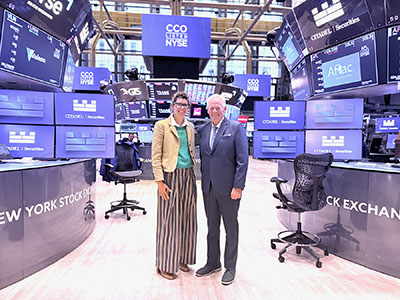
That’s the message from Tim P. McMahon,PhD, professor of practice in the Heider College of Business at Creighton University, who recently shared his insights on Today’s Marketplace, a national platform spotlighting experts shaping the future of work.
From the classroom to corporate boardrooms, McMahon sees AI as more than a tool. It’s a teammate. One that’s reshaping how companies operate, how marketers connect with customers and how the next generation of professionals will lead.

AI has left the lab and entered the office
“When I first started writing my book,” McMahon explained, “I thought I was writing about martech—marketing technology. But AI has changed everything. It’s out of the lab and into the real world now, and it’s transforming how we understand consumers.”
For McMahon, who spent decades in marketing leadership before joining Creighton, AI’s greatest power lies in its accessibility. Once reserved for Fortune 500 budgets, artificial intelligence is now leveling the playing field.
He points to small businesses as early winners. “AI has made marketing more affordable,” he said. “It helps smaller companies simulate focus groups, test new products and understand customer behavior all without spending thousands of dollars.”
The result? Small business owners can now do in hours what once took big teams and big money. It’s not science fiction; it’s simply smart business.
From focus groups to faster growth
If you’ve ever sat behind a one-way mirror for a focus group, McMahon’s example will sound familiar,until it doesn’t.
“I know people who are running simulated focus groups with no human participants at all,” he said. “AI can analyze language models and generate reliable feedback at a fraction of the time and cost.”
That kind of efficiency has fueled a surge in what experts call AI democratization, giving every business, no matter its size, access to insights once exclusive to corporations with multimillion-dollar marketing budgets.
For McMahon, this is a revolution of speed and scale: “It’s cut the time down. Cut the money down. And opened opportunities for innovation that just weren’t possible before.”
The data deluge: 14,000+ martech tools and counting
AI’s expansion, though, comes with new challenges. “Thirteen years ago,” McMahon said, “there were about 150 tools for marketing technology. Today? Over 14,000.”
That’s a 4,000% increase...and it’s still growing.
“The biggest challenge for companies,” he explained, “is building the right stack. You want your tools talking to each other, not working in silos. Coordination matters more than ever.”
Whether it’s a global enterprise or a start-up running on caffeine and code, the message is the same: AI only works when humans stay in charge of the story it tells.
Keep the human in the loop
That’s where McMahon draws a clear line.
“AI wows us with its speed,” he said. “But the danger is we start thinking it’s infallible and that we can just press a button, let it decide, and go to lunch.”
For students, professionals and leaders alike, McMahon emphasizes what he calls the human in the loop: the person behind the algorithm who interprets data, checks bias and connects insights to impact.
“You matter as a person,” he said. “Understand the data, understand how it’s leveraged and understand the outcomes. Don’t just accept the magic, understand it.”
A new kind of co-worker
As AI reshapes industries, it’s not replacing people—it’s reshaping roles.
“The risk,” McMahon warned, “is that we start depending on it for everything. AI isn’t eliminating jobs; it’s changing how people work.”
That’s why Creighton’s Heider College of Business focuses not just on technical skills, but on ethics, discernment and human-centered decision-making, hallmarks of the University’s Jesuit approach to education.
It’s a mindset that resonates with industry leaders like Mindy Simon, chief operating officer at Aon, who joined McMahon on Today’s Marketplace. “We use AI to help our clients make better decisions,” she said. “But we pair it with compliance, privacy and strong human oversight. That partnership is key.”
Advice for the next generation of AI leaders
McMahon’s message to students—and the professionals guiding them—is both practical and empowering.
“When I was coming out of school,” he said, “building software required millions of dollars and a big team. Today, anyone with an AI copilot can create simple, customized tools in a few days.”
That democratization, he argues, is transforming the modern job market. “If you’re entering the workforce in any field and you know how to bring technology to bear, even in small ways, you’re going to be invaluable.”
In other words, AI isn’t a threat. Complacency is.
Preparing students for an AI future that’s grounded in values
Creighton’s mission-driven approach to business education ensures that students don’t just learn how to use technology, but they learn why it matters.
“The ethics of AI are as important as the applications,” McMahon said. “Students need to think critically about the human consequences behind every decision they automate.”
It’s a mindset that will serve them well as they step into industries transformed by automation, analytics and AI-powered decision-making.
The bottom line
AI isn’t your competition. It’s your newest co-worker, one that can help you move faster, think smarter and create more meaningful connections, as long as you keep humanity at the heart of innovation.
Or, as McMahon puts it: “AI is here to augment our thinking, not replace it.”
The Heider College of Business’ unique approach
Explore how Creighton’s Heider College of Business is preparing students to lead with both innovation and integrity.