Creighton joins $10 million NSF initiative to strengthen STEM in Nebraska
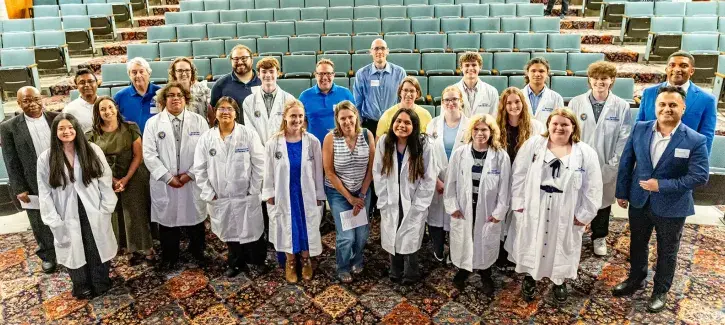
Creighton University will help expand STEM opportunities and strengthen research capacity across Nebraska as a partner in a new four-year, $10 million initiative funded by the National Science Foundation (NSF).
Nebraska Strengthening Partnerships for Innovation, Research and Education, or NSPIRE, brings together Creighton, the University of Nebraska-Lincoln, University of Nebraska at Kearney, Southeast Community College and Mid-Plains Community College. The initiative is designed to strengthen Nebraska's research and innovation ecosystem through collaboration among higher education, government and communities across the state.
The project is funded through NSF's Established Program to Stimulate Competitive Research (EPSCoR). NSPIRE will focus on four areas: administration, partnerships and collaborations, research assets and capacity, and education and workforce development.
At Creighton, that work will include continued support for the Haddix STEM Corridor Program, which provides Omaha high school students with paid, hands-on research experiences alongside Creighton faculty. Creighton will receive $470,160 over four years to support the program.
Kayode Oshin, PhD, associate professor and chair of the department of chemistry and biochemistry and director of the Haddix STEM Corridor Program, serves as Creighton's lead on the Haddix project. Juliane Strauss-Soukup, PhD, associate vice provost for Research and Scholarship and professor of chemistry and biochemistry, serves as lead of NSPIRE's Research Assets and Capacity core. Both are co-principal investigators on the grant.
Creating pathways into STEM
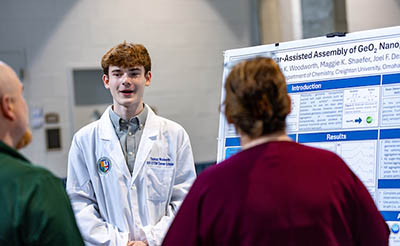
Founded in 2018 through a gift from George and Susan Haddix, the Haddix STEM Corridor Program introduces high school juniors to university-level research and potential STEM careers.
Students spend approximately eight weeks conducting research with Creighton faculty mentors, working alongside undergraduate and graduate students and learning skills ranging from laboratory safety and research methods to scientific communication. At the end of the program, students present their work at an annual research symposium.
For Oshin, those experiences align closely with NSPIRE's goals of attracting more Nebraskans to STEM careers and creating stronger connections across the state.
"Our program will support these efforts by providing students from local Omaha high schools with paid summer research experiences on Creighton University's campus," Oshin says. "The program will support traditionally underserved students and also engage those who may be first-generation college attendees."
Creighton's portion of the NSF award will support 40 high school students and their faculty mentors over the next four years.
"This program exposes curious students to actual research work at the university level and provides them with an opportunity to confirm or strengthen the passions they already have for different STEM subjects," Oshin says.
The experience also gives students an early look at college life and the range of careers available within STEM. By working alongside Creighton faculty, undergraduate students and graduate students, participants can explore their interests before making decisions about college and potential careers.
Building on the Haddix program’s impact
Since the Haddix STEM Corridor Program began, 146 high school students have conducted research with Creighton faculty in STEM departments throughout the College of Arts and Sciences, School of Pharmacy and Health Professions, School of Dentistry, College of Nursing and School of Medicine.
Program participants have gone on to pursue STEM degrees and have earned full-ride college scholarships, national scholarships and science fair awards.
Oshin says the NSF investment will allow Creighton to continue building on that foundation while connecting future participants with a broader network of STEM opportunities across Nebraska.
"This award will create new partnerships and collaborations among faculty and staff" at the participating institutions, Oshin says. It will also "open new career pathways for future high school students who participate in the Haddix STEM Corridor Program by way of internships or jobs at STEM companies within the state, and more opportunity for continued education at higher-ed institutions within our state."
Strengthening Nebraska’s research capacity
Creighton's role in NSPIRE extends beyond the Haddix STEM Corridor Program.
Strauss-Soukup will lead the initiative's Research Assets and Capacity (RAC) core, one of four areas through which NSPIRE aims to strengthen Nebraska's research ecosystem.
“The objectives of the RAC core are to increase statewide access to research services, facilities and equipment throughout Nebraska and to enhance individual and organizational capacity for pursuing research funding and impact,” Strauss-Soukup says.
The work will include developing a statewide online directory of research equipment and services, supporting research at smaller colleges, offering grant development workshops and creating a statewide pipeline to promote intellectual property and patent applications.
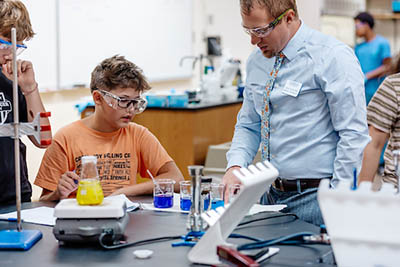
The grant will also support The Secret Life of Metals, a summer camp led by Eric Villa, PhD, professor of chemistry and biochemistry. The camp gives middle school students hands-on experience conducting chemistry experiments while Creighton undergraduate students serve as mentors.
For Villa, giving students the opportunity to conduct experiments themselves is an important part of sparking an early interest in science.
“Many students get interested in science because of a positive experience when they were younger,” Villa says. “We work to provide an engaging, positive experience to show students that science and chemistry are fun.”
Through NSPIRE, Creighton will work alongside partner institutions to strengthen research competitiveness, expand STEM career pathways and build connections among researchers, educators and communities across Nebraska.
The four-year project began in 2026, with an option for the project team to apply to NSF for a four-year renewal.
For Oshin, the funding provides an opportunity to advance research at Creighton while continuing to introduce young people to the possibilities available through STEM.
“This investment provides Creighton University with another meaningful and impactful way to fulfill one of its core missions of supporting its community by engaging local high school students,” Oshin says. “It will also support the cutting-edge research work of several faculty members creating new knowledge and advancements in their fields, while they inspire and support the next generation of high school students as they pursue their STEM passions and goals.”