Creighton physics professor earns patent for cancer treatment technology
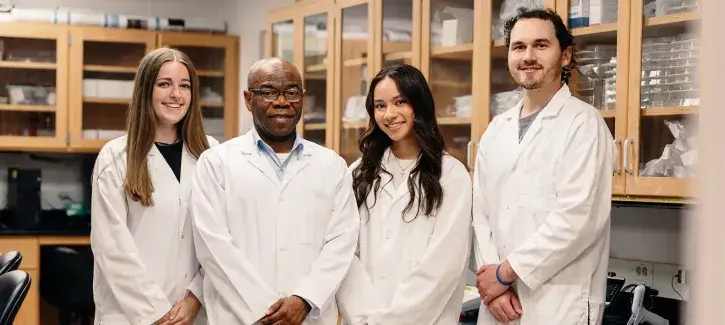
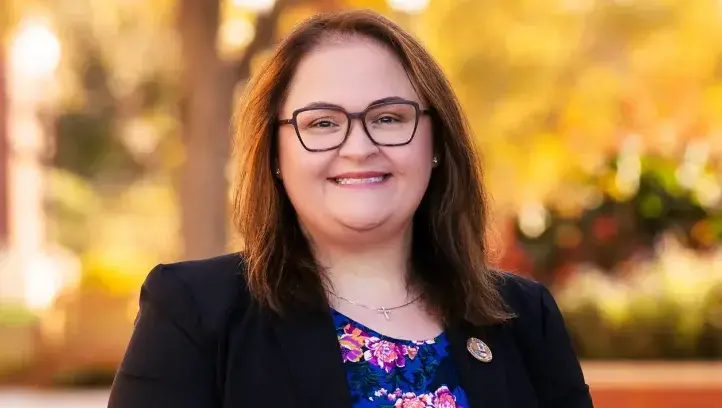
Cancer research evokes images of goggled, white coat clad chemists injecting liquid into rows of test tubes. A physicist and cryostat, not so much. But that is exactly what the Rev. Andrew E. Ekpenyong, PhD, associate professor in the Department of Physics at Creighton University, does: “I use the tools and principles of physics to tackle biomedical problems.”
Now, the research Fr. Ekpenyong has been conducting for years has earned him and five former student researchers a newly granted U.S. patent that could help advance future cancer treatments.
The United States Patent and Trademark Office (USPTO) granted and published Patent No. US12582715B1 on March 24, 2026, for an invention titled “Cancer radiation therapy with biocompatible quantum dots for simultaneous dose enhancement and counter-metastasis.” His student researchers, Caleb Thiegs, Anne Hubbard, Yohan Walter, Harrison Kramer and Kimal Honour Djam, are also named as co-inventors.
Developed through Creighton’s Translational Biomedical Physics Research Group, led by Fr. Ekpenyong, the patented technology uses specially selected biocompatible quantum dots to enhance the effectiveness of radiation therapy while helping prevent cancer from spreading. Fr. Ekpenyong describes quantum dots as lab-made artificial atoms that behave as semiconductors, and they are so minuscule that they are measured on the nanoscale.
A new approach to making radiation therapy more effective
The invention is primarily aimed at glioblastoma, one of the most aggressive and difficult-to-treat forms of brain cancer, though it may have applications for other treatment-resistant and highly metastatic cancers.
According to Fr. Ekpenyong, the technology application seeks to improve both the effectiveness and safety of radiation therapy. The quantum dots are designed to increase the radiation dose delivered directly to cancer cells while simultaneously helping to counter metastasis, the process by which cancer spreads to other parts of the body. And because the dose enhancement occurs at the tumor site after the quantum dots are targeted to cancer cells, surrounding healthy tissue receives less exposure to ionizing radiation effects. Localizing radiation as much as possible is especially vital for an organ as intricate and important to human functionality as the brain.
While the patent represents an important milestone, Fr. Ekpenyong emphasizes that significant work remains before the technology could become a clinical treatment. “A patent is not a cure and not a guaranteed new treatment modality, at least, not yet,” he cautions. “It only means we have something that works in our lab, but not yet in the clinic.”
Additional studies, preclinical testing and clinical trials will be necessary before physicians could potentially use it to care for their patients. However, securing patent protection is an important step because it encourages investment in the research and development needed to move discoveries from the laboratory to the clinic to potential FDA approval, and ultimately, adoption by physicians.
How quantum dots could improve radiation therapy
The invention builds on nearly a decade of research. Fr. Ekpenyong began studying quantum dots around 2016 and published early findings in 2018. Over the following years, he and his students tested numerous types of quantum dots, searching for one that could deliver the desired therapeutic effects. All failed. Then the COVID-19 pandemic temporarily prevented the team from conducting laboratory measurements, slowing the process further.
Then the breakthrough, which he calls “The Eureka Moment,” arrived in spring 2022. After years of trying, Fr. Ekpenyong and his team landed on the right quantum dot. The team filed a provisional patent application in October 2022. Approximately three years later, the patent was officially granted and for all 20 claims made.
Student collaboration drives medical research discovery
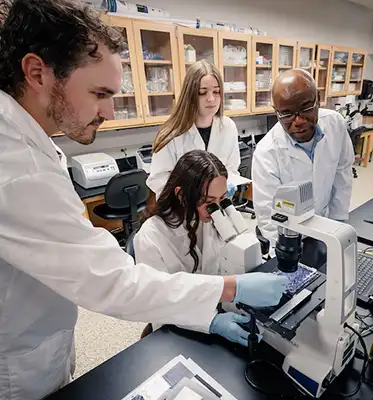
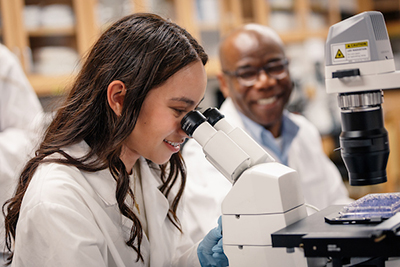
The patent highlights the critical role undergraduate and graduate students play in research at Creighton. Each of the five student co-inventors contributed to different aspects of the project, including measuring how quantum dots interact with cells, evaluating radiation dose enhancement and assessing anti-metastatic effects. Together, they helped refine and validate the invention.
“I have often told my research students that I am blessed to have them, both the graduates and undergraduates,” Fr. Ekpenyong says. “They are curious, eager to do something that saves lives, that benefits the world.”
Cancer, he notes, is a universal challenge. Not one of his students remains untouched by the disease’s reach. Using their knowledge to improve lives and serve others is a great motivator for his team.
“They are wired for Creighton’s Catholic and Jesuit mission of becoming men and women for and with others,” he continues. “They want to make the world a better place, and in my lab, we try to do that by beating cancer.”
Advancing cancer research through physics and medicine
The achievement also demonstrates the growing strength of Creighton’s research environment. Fr. Ekpenyong has studied and conducted research at internationally recognized institutions including the University of Cambridge in the United Kingdom and TU Dresden in Germany and mingled with Nobel Laureates at these institutions. But nonetheless, he sees Creighton occupying a distinctive place in higher education.
He notes that major research universities often focus heavily on graduate and postgraduate research; Creighton, however, offers students opportunities to engage in meaningful research earlier in their academic careers, and to do so in an interdisciplinary environment.
“Thanks to Creighton’s world class health sciences and biomedical programs, we have this ecosystem that brings the brightest undergraduates interested in getting an education in order to do some good in the world as nurses, doctors, medical physicists, etc.,” he says. “That is unique and amazing.”
From laboratory discovery to future clinical trials
The newly granted patent remains active through October 2044. Now, Fr. Ekpenyong and his collaborators are focused on moving the technology closer to real-world applications.
The research team, working with scientists from Iowa State University, recently submitted a proposal to the National Cancer Institute seeking National Institutes of Health funding to advance the work toward preclinical and clinical studies. Fr. Ekpenyong is also collaborating with researchers at the University of Nebraska Medical Center and exploring future partnerships with industry.
The patent is one of several innovations emerging from the Translational Biomedical Physics Research Group. A previous patent application from the group, titled “Device for Patient-Specific Prognosis,” was published in 2025. Earlier this year, Fr. Ekpenyong and two students submitted another patent application focused on AI/machine learning and therapeutic signature extraction.
For Fr. Ekpenyong, those accomplishments are launchpads for future discoveries. The group’s long-term vision is to continue applying physics, mathematics and emerging technologies such as artificial intelligence to solve pressing medical challenges.
“Absolutely and officially so,” Fr. Ekpenyong responds when asked whether his research is guided by the needs of physicians and patients. “It is in my research statement, thus: ‘I address the physician’s wish list in order to improve disease diagnosis, patient monitoring, drug development and testing, etc.’”
That mission continues to guide research that marries physics and medicine. It is work that may one day help physicians deliver safer, more effective treatments for some of the world’s most challenging diseases. “We are just beginning,” Fr. Ekpenyong asserts. “We know it works, and now we know why.”
Learn more about how Creighton’s Physics Department is advancing research at the intersection of physics, medicine and technology—and how students are helping shape discoveries that improve lives.