


NIH grant advances Creighton research into gene therapy for hearing loss
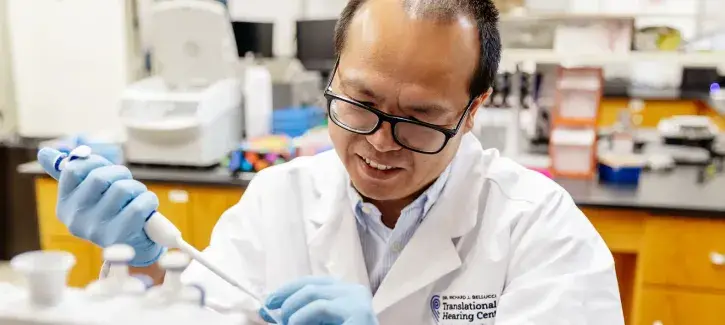
Gene therapy is creating new possibilities for treating hereditary hearing loss. At Creighton University, Litao Tao, PhD, is studying how gene regulation in the inner ear could help expand those possibilities.
The four-year award will support Tao’s research team, including a full-time postdoctoral researcher and two laboratory technicians, as well as animal studies and research materials.
Tao, an assistant professor in the Creighton University School of Medicine and researcher in the Dr. Richard J. Bellucci Translational Hearing Center, has received a $1.7 million R01 grant from the National Institutes of Health to study POU4F3, a gene essential to the development, function and survival of sensory hair cells in the inner ear.
Mutations in POU4F3 cause DFNA15, or autosomal dominant nonsyndromic hearing loss 15, which is estimated to account for 2.5% of autosomal dominant hearing loss cases.
The four-year project will investigate why mutations in POU4F3 lead to hearing loss and evaluate whether gene therapy could provide a treatment for DFNA15.
Understanding how genes are regulated
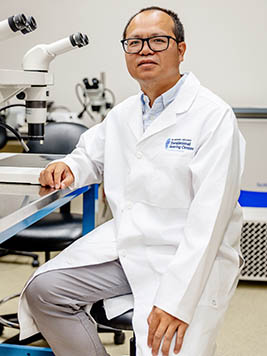
People with DFNA15 have one mutated copy of POU4F3 and one functional copy. They can maintain normal hearing function early in life before developing hearing loss over time.
Tao’s research examines what changes over time and how the regulation of POU4F3 may contribute to that hearing loss.
His research focuses on distal enhancers, regulatory regions of DNA that help control gene expression. Tao hypothesizes that POU4F3 is highly expressed during early development under the control of multiple distal enhancers. As sensory hair cells mature, some of those enhancers become inactive and POU4F3 expression decreases.
For someone with only one functional copy of POU4F3, Tao believes the decrease in POU4F3 expression could eventually leave sensory hair cells without enough POU4F3 protein to maintain normal function, leading to hair cell dysfunction and hearing loss.
Using animal models, the researchers will identify the distal enhancers that regulate POU4F3, study how insufficient gene expression leads to hearing loss and test strategies for delivering and regulating an additional functional copy of the gene.
“If we can reactivate these enhancers, we can bring the expression level up again, which can compensate for the loss of one functional copy of the gene,” Tao said.
The potential impact of gene therapy
The research comes as gene therapy has become an important area of study in hearing research.
Tao said researchers see potential for gene therapy in the inner ear because it is relatively isolated from other tissues and many of its cells do not divide again. But applying gene therapy to different forms of hereditary hearing loss also requires researchers to precisely control which cells express the therapeutic genes.
“We need a very precise way to regulate the therapeutic genes,” Tao said. “I think with our work, we can make gene therapy more feasible for many other genes.”
That is where Tao sees broader potential for his lab’s work with distal enhancers.
Tao said roughly 200 other genes are involved in hearing loss, deafness or other inner ear diseases, and many need to be expressed in specific types of cells. By identifying the distal enhancers that regulate those genes, his lab hopes to better understand how they function and how that information could eventually be used in gene therapy.
Tao’s lab is already studying the distal enhancers of GJB2, another gene associated with hereditary hearing loss. The lab ultimately hopes to build knowledge about the regulatory elements of additional genes and share those findings with other researchers studying the inner ear.
Improving diagnosis and treatment
The work could have implications for diagnosis as well as potential treatments.
Tao said that in some cases where hearing loss appears to run in families, researchers still do not know the underlying genetic cause. His lab is exploring whether mutations within distal enhancers could help account for some of those cases.
By using what researchers learn from animal models to look for mutations in human patients, Tao hopes the work can eventually contribute to more accurate diagnoses.
“Diagnosis is the first step before treatment,” Tao said.
Tao has spent his career studying hearing from several perspectives. His doctoral research examined ways to prevent hearing loss, while his postdoctoral work shifted toward identifying enhancers and studying regeneration. He brought that work to Creighton nearly five years ago.
At the Bellucci Hearing Center, Tao works alongside researchers studying different aspects of hearing, from the inner ear to the brain and from prevention to restoration.
“The environment here is great, particularly for auditory researchers,” Tao said. “For us to hear sounds, it does not just take the inner ear. It also takes the brain. We need experts from every aspect.”
For Tao, understanding the genetic mechanisms behind DFNA15 is one step toward a broader objective: learning how the regulatory regions that control genes in the inner ear could contribute to better diagnosis and potential treatments for hereditary hearing loss.


