Two minutes with Pope Leo XIV
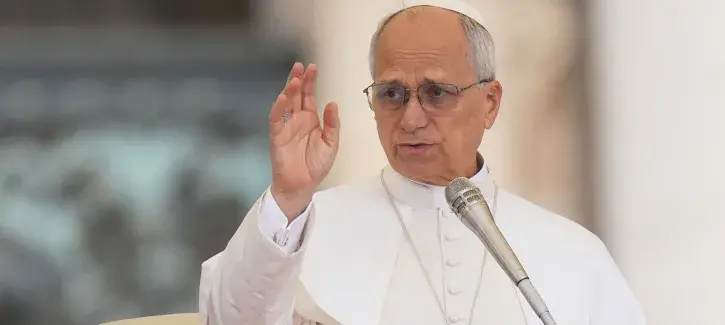
If you had just two minutes alone with the new pope, what would you say? Would you offer advice? Raise concerns? Ask him to act?
These questions were posed to several faculty members from the Creighton Department of Theology. Their responses echoed a shared conviction: Pope Leo XIV must carry forward the spirit of Vatican II — with boldness, humility and a commitment to dialogue. From Christian unity to migration, justice to technology, they called for a papacy rooted not in power, but in listening, collaboration and lived experience.
Christian Unity and the Papacy’s Role
H. Ashley Hall, PhD, associate professor and department chair, emphasized the need to continue ecumenical dialogue begun by Pope John XXIII and Vatican II to heal the rift among Christian churches.
“I would say people are used to Christians fighting and not manifesting the unity that we’re called to share in Jesus Christ,” Hall says. “The critical issue here is the theological perspective that our baptism makes us one, as the letter to the Ephesians says: ‘one faith, one Lord, one baptism.’ So we have a moral or theological imperative as faithful disciples where we try to make that unity apparent.
“What is at stake is the credibility of the Christian witness in a secularized world. People aren’t asking, ‘Should I be Anglican or Roman Catholic or Baptist?’ They are asking, ‘Why be Christian at all?’”
Hall pointed to Pope John Paul II’s encyclical Ut Unum Sint (“That They May All Be One”) as a key moment in that ecumenical journey. That work, later supported by Popes Benedict XVI and Francis, should be carried forward, he says, with Pope Leo using the papal office to keep denominations in honest, sustained conversation.
Universal Destination of Goods
Aimee Hein, PhD, assistant professor of theology, says she would ask Pope Leo to address migration and the global inequality behind it. She quoted Pope Paul VI, who cited the classic Roman Catholic principle of the Universal Destination of Goods, expressed definitively by Vatican II: “God intended the earth and everything in it for the use of all human beings and peoples. Thus, under the leadership of justice and in the company of charity, created goods should flow fairly to all.”
“Pope Paul VI said explicitly that all other rights are subordinate to this principle,” Hein says. “Catholic social teaching on immigration also tends to start from an assertion that people have a right to live a life of dignity where they are, and the right to migrate when they are unable to do that.
“This calls our attention to global inequalities and violence that push people to migrate, prompting a reconsideration of our world,” she continues. “I would like to see Pope Leo emphasize our responsibility to people who are migrating now, but also to create a world where people don’t have to migrate if they don’t want to. I would love to see Leo emphasize the common good and remind us that it’s our responsibility to take care of each other and take care of creation — what we are called to do and have a responsibility to do, for and with one another.”
Listening to the Faithful
Sherri Brown, PhD, professor of theology, says she would ask Pope Leo to elevate the voices that are often unheard.
“The leadership in our world is too encumbered by the voices of the wealthy, the powerful and the greedy,” she says. “He must listen to the voices of, and thereby give voice to, the vibrant, struggling, active, faithful everyday Christian people around the world. He must then reflect upon all that he hears through the lens of Scripture …the Christian Scriptures teach that each and every human being is created in the image and likeness of God. Each and every human being, therefore, must be able to live in their own right, to live a life of their own choosing. The Church, with the pope as its faith and moral leader, must take a stand to allow for a shared future that is safe, liberative and fruitful for all God’s people, meaning all humankind.”
Faith, Restlessness and the Digital Age
Jay Carney, PhD, professor of theology and Graff Chair in Catholic Theological Studies, says, as a practicing Catholic, he would ask Pope Leo for a blessing and then to pray with him. Then, Carney says he would ask the first Augustinian pope to reflect on a line from Confessions.
“I would ask Pope Leo … to reflect on the meaning of St. Augustine’s famous quote from Confessions here in the 21st century, ‘Our hearts are restless until they rest in thee,’” Carney says. “How can we help people channel their restlessness and desire toward God, the good and love of others? I would also encourage him to write an encyclical on technology, artificial intelligence, Catholic social teaching and what it means to be fully human amidst all these rapid developments.”