Creighton researcher joins $1.37M effort to target aortic valve disease
For those living with calcific aortic valve disease (CAVD), walking to the end of the block feels like a mountain hike. Puttering in your garden is exhausting. Grocery shopping leaves you drained, if you are even able to navigate your cart down the aisles. You’re simply tired of being tired.
But a Creighton University researcher is helping lead an effort to uncover potential treatments for aortic valve calcification, a serious cardiovascular condition for which there are currently no medications that can stop or reverse the disease.
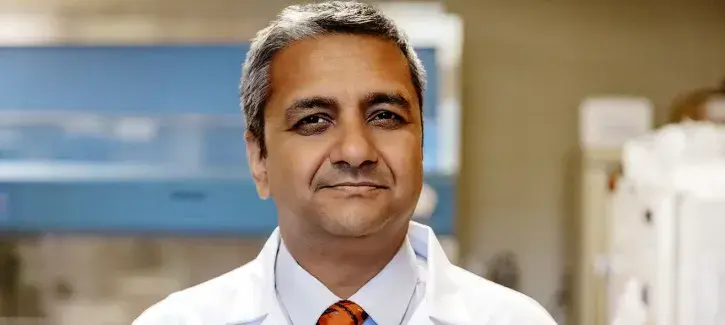
Aurijit Sarkar, PhD, associate professor of pharmacy sciences in Creighton’s School of Pharmacy and Health Professions, is serving as a co-principal investigator on a $1.37 million American Heart Association Strategic Network Project Award that will investigate the biological pathways connecting genetic risk to CAVD. The four-year project, led by researchers at the University of Pittsburgh, runs through March 2030 and is part of a larger AHA Strategic Network Center supporting three research projects with more than $4 million in total funding.
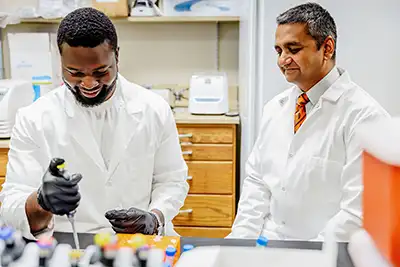
Creighton’s role is focused on drug discovery and design. Sarkar’s team is working to identify compounds that could prevent the calcification of the aortic valve by disrupting an interaction between two proteins that are essential for calcification to occur.
“This is very early preclinical work,” Sarkar says. “Our goal in this project is to unravel the mysteries of aortic valve calcification on a very foundational level, first.”
How aortic valve calcification begins
The aortic valve regulates blood flow from the heart to the rest of the body. As people age, calcium can accumulate on the valve, causing it to become stiff and restricting blood flow. This calcification can contribute to aortic stenosis, a serious cardiovascular condition.
Patients may experience exhaustion with even light exercise, difficulty breathing, chest pain, wheezing or lightheadedness. By the time symptoms appear, however, the disease may already be well established.
For years, aortic valve calcification was viewed largely as a benign consequence of aging. Researchers now understand that it can have serious consequences—including heart failure and stroke. Despite the prevalence of statin therapy, there are no medications that specifically prevent or reverse the calcification.
The new research builds on findings from Cynthia St. Hilaire, PhD, lead researcher and Center for Integrative Valve Science director, and her team at the University of Pittsburgh. They found that the two proteins mistakenly lock onto one another, and that physical connection drives the disease process. This interaction triggers a destructive process called “osteogenic reprogramming,” a biochemical shift that essentially tricks the soft, flexible cells of the heart valve into acting like hard, bone-building cells. The cells begin absorbing and depositing calcium, causing the valve to stiffen and lose elasticity. Blood flow becomes dysregulated.
Creighton researchers target CAVD through drug discovery
That finding gives Sarkar and his team a potential target for transforming theory into a potential medical breakthrough.
“If we can prevent these proteins from interacting, we may be able to prevent calcification,” Sarkar says.
But designing a compound capable of doing that is immensely challenging. “It is hard to identify chemicals that will prevent these proteins from interacting because proteins are large and typically form many different contacts when they meet,” Sarkar says. His team must first determine which of those contacts are most responsible for making the proteins bind together. From there, they can begin designing chemicals capable of disrupting those critical contacts.
“We have a systematic process to overcome this problem,” he says. The team will evaluate potential compounds based first on whether they can prevent valve calcification. Potency will also be important. A compound that works at a very low concentration may be more promising and could potentially reduce the risk of toxicity and mitigate potential harm to healthy tissue.
A collaborative approach to calcific aortic valve disease
Sarkar’s drug-design work is one part of a broader research strategy.
Researchers at the University of Pittsburgh are working to identify patients at risk for CAVD earlier by examining clinical imaging and biomarkers and applying artificial intelligence to support early diagnosis. At Worcester Polytechnic Institute, researchers are investigating how mechanical stress caused by blood flow through the aortic valve may contribute to calcification.
Together, the projects approach CAVD from multiple directions: identifying who is at risk, understanding what drives the disease and finding ways to prevent its progression.
“Dr. Satoshi Okawa at the University of Pittsburgh is leading the effort to identify CAVD patients early by identifying patient characteristics through clinical imaging, biomarkers and artificial intelligence algorithms,” Sarkar says. “We are also working with Dr. Kristen Billiar from Worcester Polytechnic Institute to understand how mechanical stress during blood flow through the valve might affect calcification.”
“Put together, our projects take a holistic view of the problem and address what factors increase the risk and severity of CAVD,” he continues.
That collaboration is particularly important because the research is focused on a disease that remains poorly understood.
“The very foundations of aortic valve calcification are understudied,” Sarkar says. The researchers hope that a better understanding of those foundations will reveal opportunities to intervene before the disease progresses.
From laboratory discovery to potential CAVD treatment
Any potential compound identified through the project would only represent an early step toward a treatment. Sarkar emphasizes that the Creighton team is not currently conducting research in patients and that significant laboratory, preclinical and clinical work would be required before a drug could be tested as a treatment.
“On average, it takes pharmaceutical companies well over 10 years and an investment of more than $1.5 billion to bring a drug to market,” he says. The immediate goal is more foundational: “to unravel the mysteries of aortic valve calcification” by determining whether disrupting the two proteins’ interaction can safely reduce calcification.
“Good science ensures safety is a priority, even at the cost of slowing down research output,” Sarkar says. “If we are able to demonstrate the ability to reduce calcification safely for this first step spanning four years, we will be satisfied.”
The long-term hope is that those discoveries could eventually promote understanding of disease progress, help physicians identify patients at risk earlier and provide them with effective options before CAVD becomes severe and, ultimately, prevent the disease from occurring.
“We hope that eventually our work will help physicians identify patients at risk for valve calcification, and help them with good treatments,” Sarkar says.
Learn more about research at Creighton University aimed at understanding cardiovascular disease and developing new approaches to prevention and treatment.