Creighton research seeks ways to prevent sudden deaths from epilepsy
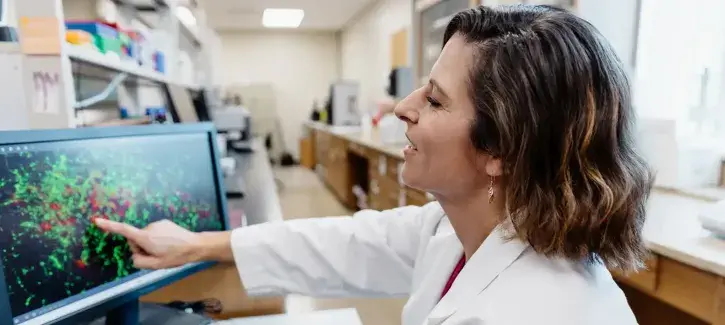
Kristina Simeone, PhD, professor and director of the Master of Science in Neuroscience Program, has received a five-year, $2.45 million grant from the National Institutes of Health to examine how chronic stress may affect the risk of sudden unexpected death in epilepsy, known as SUDEP. has received a five-year, $2.45 million grant from the National Institutes of Health to examine how chronic stress may affect the risk of sudden unexpected death in epilepsy, known as SUDEP.
The project is funded by the National Institute of Neurological Disorders and Stroke. Simeone is leading the research with Cameron Metcalf, PhD, of the University of Utah.
Identifying factors that could change SUDEP risk
SUDEP occurs when a person with epilepsy dies suddenly and no other cause of death is identified. Simeone says people who experience severe seizures or seizures that do not respond to medication face a risk of about 1 in 150. Certain genetic mutations can also increase risk.
Yet not everyone who dies from SUDEP has those known risk factors, and many people who have them do not die from SUDEP.
That leaves researchers with two critical questions: What other factors increase the risk, and what might protect someone from it?

“Our long-term goal is to identify modifiable risk factors,” Simeone says. “These are things people have control over that could increase their risk or decrease their risk and potentially prolong their lifespan.”
For more than a decade, Simeone’s laboratory has studied SUDEP using preclinical models. Her team previously discovered that chronic sleep problems increase SUDEP risk. That finding was later studied clinically and ‘improved sleep hygiene’ was incorporated into treatment strategies to lower SUDEP risk.
The new project will explore whether stress could be another modifiable factor.
Stress can affect the body in different ways. Some stress can build resilience and strengthen aspects of the body’s physiology, while too much stress can increase the risk of death. The researchers will examine two interconnected stress responses involving the pituitary gland and sympathetic nervous system.
The researchers will use two genetic preclinical models of SUDEP to study whether chronic stress affects longevity. The models experience spontaneous, recurring seizures and seizure-induced sudden death, allowing the team to determine whether stress shortens or prolongs lifespan.
“It doesn’t matter which way the data go,” Simeone says. “Stress may increase SUDEP risk, or it may offer some protection and reduce risk. Either way, the findings will be relevant to people with epilepsy.”
Understanding the body’s ability to recover
The team will also investigate how stress affects autoresuscitation, the body’s automatic response that causes someone to begin breathing again after prolonged apnea.
During prolonged apnea, oxygen levels fall and carbon dioxide levels rise, and circuits in the brain normally trigger breathing and will wake a person if they are sleeping. This is the autoresuscitation response. If the brain cannot detect these changes in oxygen and carbon dioxide to trigger breathing, the person will not survive, and the apnea will be terminal.
Clinical reports indicate that many people who die from SUDEP experience a severe seizure followed by prolonged terminal apnea, from which they are unable to autoresuscitate.
Simeone’s team previously found that this response does not function properly in preclinical models of SUDEP and developed new tests to study it.
“Often after a severe seizure with prolonged apnea, people are able to start breathing (and wake up if not conscious) and continue to live,” Simeone says. “A majority of SUDEP victims have survived severe seizures in their past, but they were unable to autoresuscitate from their last one. We’re investigating what is responsible for triggering this response and whether stress makes it better or worse.”
Learning from families affected by SUDEP
Simeone’s research is shaped in part by conversations with clinicians, advocates and families who have lost loved ones to SUDEP. She serves as co-chair of an international SUDEP research and prevention committee that brings together scientists, healthcare professionals, educators, public policy experts and advocates.
At a conference for families affected by epilepsy-related deaths, Simeone repeatedly heard caregivers describe stress, illness and other changes they had observed shortly before losing a loved one.
“There were all of these experiences from families and caregivers that weren’t available in the scientific literature to help guide future research,” Simeone says.
She later conducted a survey of caregivers to document those observations and help guide future research.
By connecting laboratory findings with the experiences of patients, families and clinicians, Simeone hopes the research will eventually lead to practical recommendations people with epilepsy can use to reduce their risk.
“My goal as a basic scientist has always been to identify a clinical problem, study it through basic science and then translate what we learn back into clinical practice,” Simeone says.