


Is recycling actually working?
Is Recycling Actually Working? It Depends—Here’s What to Know
Recycling is often framed as an easy win. Put the right item in the right bin, and you have done your part.
But the reality is more complex.
“Is recycling actually working? It depends on where you’re at in the country,” says Andrew Baruth from Creighton’s Office of Sustainability Programs. “In some places it’s working really well. In some places, it doesn’t work as well.”

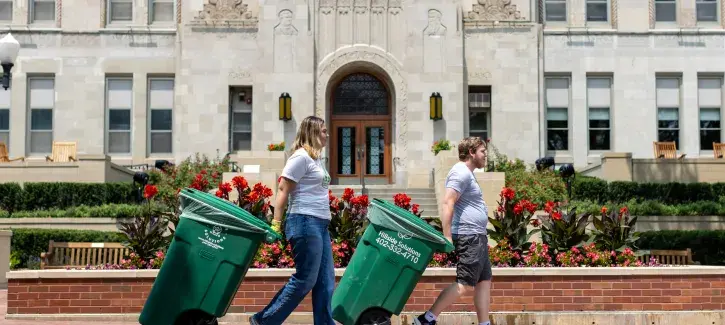
That difference comes down to infrastructure, access and how well systems are designed to handle materials after they are collected. At Creighton, those systems are in place. Recycling from campus is transported to a regional facility where materials like paper, aluminum and cardboard are sorted into marketable resources and prepared for reuse.
In other words, when recycling is done correctly here, it has a real path forward.
Where Recycling Breaks Down
The biggest challenge is not always the system. It is how people use it.
One of the most common issues is something known as wish cycling. It is the assumption that as long as an item ends up in a recycling bin, it will be taken care of.
In practice, that mindset can do more harm than good. When non-recyclable items are mixed into the system, they can contaminate entire batches of material. That makes it harder, and sometimes impossible, to recover items that could have been recycled.
The result is a process that depends just as much on informed decisions as it does on infrastructure. Knowing what belongs in each bin is what allows the system to work as intended.
Not Everything Is Recyclable in the Same Way
Another misconception is that all materials are equal once they reach a recycling facility.
Some materials hold their value indefinitely. Aluminum, for example, can be recycled again and again without losing quality. Others, especially plastics, are far more difficult to process and often cannot be turned back into the same product.
“Plastics in particular … it’s just really hard to convert those back to something like a plastic bottle,” Baruth explains.
That limitation changes the conversation. Recycling is not always a closed loop, and in many cases, it is only a partial solution.
Shifting the Focus to Reuse
Because of those limitations, Creighton’s approach to sustainability goes beyond recycling.
The priority is reducing waste before it ever enters the system. That can be as simple as choosing reusable items instead of single-use ones, or as complex as rethinking how materials are used across campus operations.
This mindset is reflected in initiatives like Creighton’s reusable to-go container program. By replacing disposable containers with durable alternatives, the University is keeping about 40,000 containers each year out of landfills and compost streams.
It is a shift from managing waste to preventing it.
A Broader Commitment to Sustainability
These efforts are part of a larger, mission-driven approach to sustainability at Creighton.
Through the Sustainable Creighton Initiative, the University is focused on reducing emissions, improving waste diversion and engaging students in meaningful environmental action. Rooted in Jesuit values, this work reflects a commitment to caring for our common home and responding to environmental challenges with both urgency and intention.
That commitment shows up in both everyday actions and large-scale change. Creighton recently announced a transition to renewable energy for a significant portion of its campus cooling systems, reducing its carbon footprint by 21%.
So, Is Recycling Working?
The answer is yes, when the system is strong and people use it correctly.
But recycling is not the goal. It is one piece of a much larger solution.
The most meaningful impact comes from reducing what we use, rethinking how systems are designed and making choices that prevent waste in the first place.


